May 25 2008
It´s been raining more than usual in Ambuqui these past few weeks; the locals don´t know what to make of it. Normally this is the start of a very dry season in a very dry region. But things are different this year, everyone says so; no one knows why. Along with the rains have come chillier temperatures, though nothing compared to the damp piercing cold of places set in higher altitudes, places like San Gabriel, La Paz, or Tulcan. Especially Tulcan. Nevertheless the people of Ambuqui walk about, (or huddle under awnings, depending on the rain) in sweaters and shawls, muttering phrases like ¨Aychaychay¨ (Quichua for cold), and ¨bien frio hoy¨ which in loosely translated Spanish means ¨damn it´s cold today.¨ Luckily for us, here in the valley, the rain and cooler temps do not usually stay long; they are often bracketed by glorious days of bright hot sunshine, blue skies and windblown clouds, wispy remnants of the rainmakers still active up in the mountains.
The rain in the mountains has been another matter altogether. Dry quebradas flood with rushing waters, cutting pueblos off from one another, from markets, from communications. Soils and rock erode unchecked from steep hillsides and either block, or cause the collapse of, the dirt tracks that pass for roads in the less inhabited parts of the province. The mud is so deep and so slippery that it is all but impossible to walk any path; rubber farm boots with deeply lugged soles are the preferred footwear for those who can afford such a luxury. Others go barefoot, toes curled, calves and thighs tensed against the inevitable slipping and sliding. Roofs leak, crops are ruined, chickens die. The people wait for the rains to end, but when?
This afternoon, in the misty rain falling in Ambuqui, I was sitting on my stoop, watching the neighborhood kids play a very complex version of marbles and eating my lunch. Juanita, the mother of one of the boys, passed by in a full run and called out ¨come, come to the quebrada!¨ There were other words as well, but I did not understand. The boys stopped their game, leaving their marbles in the street, and ran off behind her. ¨What´s happening,¨ I shouted, and Jerald, the son, turned and said ¨cerdos! En la quebrada! Venga! - ¨Pigs, in the waterway, come!¨
By the time I reached the quebrada, the pigs, if there had been pigs, were long gone. The volume of water and the speed at which it flowed was mind boggling. If pigs had indeed been caught up in that torrent they would never survive. Nothing would. It was a remarkable sight, matched only by the crushing sound of rushing water. Black, muddy, angry water. I scanned the viewable length of the quebrada – and was startled to see a hundred or more people lining the banks, standing and watching. Watching for pigs? Probably not. More likely they were looking only at the water, and no doubt some were wondering why, with so much water, was there not enough for irrigation; others perhaps wondering why, with so much water, was there not enough for cooking and bathing and washing?
Somewhat later I caught up with Juanita, and I asked her about the pigs. ¨Yes there were pigs¨, she said, ¨three, but all were dead, because of the water. The owners have found them, on the rocks below the bridge, and will take them home for butchering.¨
Tuesday, June 10, 2008

Tuesday, April 8, 2008
aqui, no mas

I bought a used Dell laptop in Quito two months ago, and it´s been a pleasure to have around, for writing and preparing work reports and charlas, for photo storage and music trading, and for watching a movie every now and again. Decent quality pirated DVDs can be bought all over for a 1.50, and somehow some movies are available here before they make their big screen debuts in LosEstadosUnidos, otherwise known as ¨allᨠ(there). I recently watched ¨Into the Wild¨ and the Michelangelo Antonioni classic ¨La Aventura¨. (preferred ¨Into the Wild¨) It gets dark here reliably each night at 6:30, and while I often entertain myself with sitting in the park and chatting for a while, or reading at home, it is nice to chill with a good movie now and again before crawling in around 9 PM.
Anyway, I thought that my computer might make me a better, more reliable blogger, but as the dates between posts indicates, that has not been the case. I am just as lazy as ever, or maybe just as boring. Life has settled into a very comfortable pattern, interrupted only occasionally by the spectacle of a truck plummeting down a cliff (driver lived) or a bad case of the shits brought on by some yummy smelling unidentified meat on any street corner. I was laid up for four days during Carnaval with such a condition, and I missed everything – all the dancing, all the drinking, all the debauchery. Well, there´s always next year.
Basically, there is work, which is challenging and ever-changing, and then there is all the other stuff. Like cooking, washing clothes, bathing (occasionally), and housecleaning (more occasionally). I cook a small breakfast every morning, coffee and a local type of oatmeal made with quinoa. I usually dump a ton of panela and cinnamon on top – panela is a type of brown sugar made in the local cane plantations. I don´t have a refrigerator, so my fresh ingredient list is limited to whatever I can buy here in Ambuqui and keep in the kitchen for a day or two. I always have a few mangos and avocados lying around, and lemons for lemonade are free for the picking. Occassionally the local tienda will have some good ¨carne de vaca¨ (meat of the cow), and I will cook up some rice and a bunch of veggies for a small feast. I cook all my meals on a little 3 burner stove top, which is attached to a tank of gas which sits in my kitchen. Propane is subsidized here, a tankful of cooking gas (minus deposit) costs 2.50, I have had the same tank for 10 months. For most families, who cook for many people every day a tank will last a month or so. Then there are the many households that do not use gas for cooking, but for various reasons continue to cook over wood fires, inside the home. This custom persists despite the relative lack of available wood, the low price of propane, and the ever present coughs and throat ailments of the residents.
We often have running water, but it is never a sure thing, so my clothes washing schedule is based on first checking to see if there´s water. If so, I put all my clothes in a big blue bucket, go outside, fill with water and detergent, and then let it sit for a few hours. Later I will swoosh the clothes around a little, dump out the old water, and fill with new water and swoosh around again. When I think that I have most of the soap out, I wring each piece and hang it on the line to dry. Here in Ambuqui clothes dry in a few hours, but in some places like Cayambe, Runipamba, or Urcuqui, it can take days. My meager cooking and laundering routines are nothing compared to the arduous housekeeping activities of the women. Entire days, or weekends, can be spent washing, rinsing, and hanging to dry. Some families who have no water wash their clothes and dishes in the irrigation ditches or in the river. They lay their clothes out on river rocks to dry.
Preparing food – a never ending task of shelling beans, shucking corn, cooking rice, killing and plucking chickens, washing and peeling potatos, boiling pots all day long for soups, etc. Somehow these women have enough energy to go to health charlas or community bank meetings in the evenings, meanwhile the menfolk are continuing their normal day of drinking, gambling, and carousing. And it´s a common enough fact that I won´t apologize for the generalization.
I do have a shower, cold water only, and many´s the time I´ve been stranded all lathered up when the water quits. So I keep a 20 gallon bucket of water in the shower stall so I can finish up, and also it provides a back up supply of water for flushing the toilet. Most people in town have a shower, but some still bathe in the ditches, the river, or out by the laundry tank. On the occasions when we go without water for 4 or 5 days many more can be found washing up outdoors. All this in a town where I am sitting in the biblioteca connected to wireless internet. Some forms of progress are easier and cheaper than others, I suppose.
Anyway, I thought that my computer might make me a better, more reliable blogger, but as the dates between posts indicates, that has not been the case. I am just as lazy as ever, or maybe just as boring. Life has settled into a very comfortable pattern, interrupted only occasionally by the spectacle of a truck plummeting down a cliff (driver lived) or a bad case of the shits brought on by some yummy smelling unidentified meat on any street corner. I was laid up for four days during Carnaval with such a condition, and I missed everything – all the dancing, all the drinking, all the debauchery. Well, there´s always next year.
Basically, there is work, which is challenging and ever-changing, and then there is all the other stuff. Like cooking, washing clothes, bathing (occasionally), and housecleaning (more occasionally). I cook a small breakfast every morning, coffee and a local type of oatmeal made with quinoa. I usually dump a ton of panela and cinnamon on top – panela is a type of brown sugar made in the local cane plantations. I don´t have a refrigerator, so my fresh ingredient list is limited to whatever I can buy here in Ambuqui and keep in the kitchen for a day or two. I always have a few mangos and avocados lying around, and lemons for lemonade are free for the picking. Occassionally the local tienda will have some good ¨carne de vaca¨ (meat of the cow), and I will cook up some rice and a bunch of veggies for a small feast. I cook all my meals on a little 3 burner stove top, which is attached to a tank of gas which sits in my kitchen. Propane is subsidized here, a tankful of cooking gas (minus deposit) costs 2.50, I have had the same tank for 10 months. For most families, who cook for many people every day a tank will last a month or so. Then there are the many households that do not use gas for cooking, but for various reasons continue to cook over wood fires, inside the home. This custom persists despite the relative lack of available wood, the low price of propane, and the ever present coughs and throat ailments of the residents.
We often have running water, but it is never a sure thing, so my clothes washing schedule is based on first checking to see if there´s water. If so, I put all my clothes in a big blue bucket, go outside, fill with water and detergent, and then let it sit for a few hours. Later I will swoosh the clothes around a little, dump out the old water, and fill with new water and swoosh around again. When I think that I have most of the soap out, I wring each piece and hang it on the line to dry. Here in Ambuqui clothes dry in a few hours, but in some places like Cayambe, Runipamba, or Urcuqui, it can take days. My meager cooking and laundering routines are nothing compared to the arduous housekeeping activities of the women. Entire days, or weekends, can be spent washing, rinsing, and hanging to dry. Some families who have no water wash their clothes and dishes in the irrigation ditches or in the river. They lay their clothes out on river rocks to dry.
Preparing food – a never ending task of shelling beans, shucking corn, cooking rice, killing and plucking chickens, washing and peeling potatos, boiling pots all day long for soups, etc. Somehow these women have enough energy to go to health charlas or community bank meetings in the evenings, meanwhile the menfolk are continuing their normal day of drinking, gambling, and carousing. And it´s a common enough fact that I won´t apologize for the generalization.
I do have a shower, cold water only, and many´s the time I´ve been stranded all lathered up when the water quits. So I keep a 20 gallon bucket of water in the shower stall so I can finish up, and also it provides a back up supply of water for flushing the toilet. Most people in town have a shower, but some still bathe in the ditches, the river, or out by the laundry tank. On the occasions when we go without water for 4 or 5 days many more can be found washing up outdoors. All this in a town where I am sitting in the biblioteca connected to wireless internet. Some forms of progress are easier and cheaper than others, I suppose.
Thursday, February 7, 2008
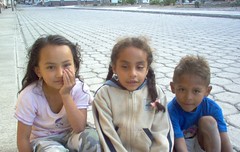
Ambuqui kids
Recently we were forwarded a New York Times op-ed piece written by former PCV and later country director Robert L. Strauss. I, along with hundreds of other PCV´s wrote a reply to his comments. At the end of my comments I have posted the link, if anyone cares to read the original piece. Any comments on content or grammar are welcome!
-------
I read with interest the recent op-ed pieces regarding the Peace Corps. I would like to make a few comments, from the point of view of a 52 year old volunteer with many years of agricultural and community organizing experience.
1 – Regarding the question of bringing in more volunteers over the age of 50 – it´s a great idea. Older volunteers walk into a community and for the most part have instant credibility, irregardless of credentials. Most of us have, or have had, spouses, children, or businesses, and have experienced all the ups and downs associated. Most of the people we work with will have had similar experiences, certainly with regards to children and families. Even teaching volunteers will have plenty of interaction with other adults, administrators, teachers, and parents. They will all be curious about the older volunteers life – why did you decide to come here, where are your children, where is your spouse, how is life different here than in the U.S. – the questions will be sincere, and limitless. Younger volunteers are often seen (sometimes unfairly) more as adventurers, looking for a little fun and experience before starting a life back in the US.
One caveat – pay special attention to language acquisition for older volunteers! During training the older volunteer should be offered full days and weeks of language immersion – it is likely safe to assume that he or she has extensive, or at least sufficient, technical expertise.
2 – Specialists vs Generalists: This question is as old as Peace Corps itself! There is really only one answer, which is of course, both. There are no guarantees that a specialist can adequately teach, adapt to a new culture and a somewhat lower standard of living, or adapt to the realities of lowered expectations. Conversely, there is no reason to expect that a generalist, fresh out of college, can not apply themselves and quickly learn pertinent skills that will ultimately assist their communities. The most important skill of any volunteer is flexibility – the dogma of specialization rarely has a place in the life of a Peace Corps Volunteer.
A successful PCV will be a multitasker par excellence, for the reality is that in any given month (say, for an AG volunteer, like myself) we may speak to a group of 40 to 50 about food security and nutrition; a group of 14 or 15 about specific pest problems on specific crops; we may spend an hour or two once a week teaching English to whoever shows up. We may be asked by the local health center to prepare a talk about domestic violence, or birth control. We may spend a grueling day, or week, digging fish ponds or building terraces on hillsides way too steep for conventional farming. We may spend an evening talking with a local women’s group about community banks, or about the best way to market the delicious jam they create from local fruits. And of course, many of us will take gulps of time for continued language training, either in the privacy of our quarters, or, even better, on a street corner sharing a cerveza or a platter of horno.
However, the most important work we will do is to share our humanity, our common bonds. To rejoice in small successes, and to flounder a little over our failures. To take a short walk along the coast with a neighbor, or hike in the mountains with a group of children who are thrilled beyond belief that you agreed to go with them. To admit to our new friends our fears and our questions, and our concerns, and to soothe them when they admit theirs, to us. Not a week goes by when I don’t wonder at least once – what the hell am I doing here? And without fail, I receive 10 or 15 affirmative reasons, every single week.
Former volunteer, recruiter, and country director Robert L. Strauss is, very surprisingly, looking at Peace Corps through a very small lens, if one is to be guided by his recently published opinions. Without a doubt, Peace Corps, like all agencies, should be in a constant state of examination and retooling. Also, without a doubt, Peace Corps is an incredibly successful concept and organization, by any standard of measurement. And it cannot be ignored that the ENTIRE annual budget of Peace Corps worldwide amounts to less than 2 days of war expenditures in Iraq. Let’s have some serious conversations about the real problems in America’s foreign policies – and less carping about Peace Corps, one of the best tools America has ever had to improve its image in a world that simultaneously grows smaller yet farther apart.
http://www.nytimes.com/2008/01/09/opinion/09strauss.html?_r=1&ref=opinion&oref=slogin
-------
I read with interest the recent op-ed pieces regarding the Peace Corps. I would like to make a few comments, from the point of view of a 52 year old volunteer with many years of agricultural and community organizing experience.
1 – Regarding the question of bringing in more volunteers over the age of 50 – it´s a great idea. Older volunteers walk into a community and for the most part have instant credibility, irregardless of credentials. Most of us have, or have had, spouses, children, or businesses, and have experienced all the ups and downs associated. Most of the people we work with will have had similar experiences, certainly with regards to children and families. Even teaching volunteers will have plenty of interaction with other adults, administrators, teachers, and parents. They will all be curious about the older volunteers life – why did you decide to come here, where are your children, where is your spouse, how is life different here than in the U.S. – the questions will be sincere, and limitless. Younger volunteers are often seen (sometimes unfairly) more as adventurers, looking for a little fun and experience before starting a life back in the US.
One caveat – pay special attention to language acquisition for older volunteers! During training the older volunteer should be offered full days and weeks of language immersion – it is likely safe to assume that he or she has extensive, or at least sufficient, technical expertise.
2 – Specialists vs Generalists: This question is as old as Peace Corps itself! There is really only one answer, which is of course, both. There are no guarantees that a specialist can adequately teach, adapt to a new culture and a somewhat lower standard of living, or adapt to the realities of lowered expectations. Conversely, there is no reason to expect that a generalist, fresh out of college, can not apply themselves and quickly learn pertinent skills that will ultimately assist their communities. The most important skill of any volunteer is flexibility – the dogma of specialization rarely has a place in the life of a Peace Corps Volunteer.
A successful PCV will be a multitasker par excellence, for the reality is that in any given month (say, for an AG volunteer, like myself) we may speak to a group of 40 to 50 about food security and nutrition; a group of 14 or 15 about specific pest problems on specific crops; we may spend an hour or two once a week teaching English to whoever shows up. We may be asked by the local health center to prepare a talk about domestic violence, or birth control. We may spend a grueling day, or week, digging fish ponds or building terraces on hillsides way too steep for conventional farming. We may spend an evening talking with a local women’s group about community banks, or about the best way to market the delicious jam they create from local fruits. And of course, many of us will take gulps of time for continued language training, either in the privacy of our quarters, or, even better, on a street corner sharing a cerveza or a platter of horno.
However, the most important work we will do is to share our humanity, our common bonds. To rejoice in small successes, and to flounder a little over our failures. To take a short walk along the coast with a neighbor, or hike in the mountains with a group of children who are thrilled beyond belief that you agreed to go with them. To admit to our new friends our fears and our questions, and our concerns, and to soothe them when they admit theirs, to us. Not a week goes by when I don’t wonder at least once – what the hell am I doing here? And without fail, I receive 10 or 15 affirmative reasons, every single week.
Former volunteer, recruiter, and country director Robert L. Strauss is, very surprisingly, looking at Peace Corps through a very small lens, if one is to be guided by his recently published opinions. Without a doubt, Peace Corps, like all agencies, should be in a constant state of examination and retooling. Also, without a doubt, Peace Corps is an incredibly successful concept and organization, by any standard of measurement. And it cannot be ignored that the ENTIRE annual budget of Peace Corps worldwide amounts to less than 2 days of war expenditures in Iraq. Let’s have some serious conversations about the real problems in America’s foreign policies – and less carping about Peace Corps, one of the best tools America has ever had to improve its image in a world that simultaneously grows smaller yet farther apart.
http://www.nytimes.com/2008/01/09/opinion/09strauss.html?_r=1&ref=opinion&oref=slogin
Saturday, November 24, 2007
I’ve just passed my first month in Ambuqui, my new home here in Ecuador. A rolling stone gathers no moss they say; most of my life has been spent on the move, so I suppose I shouldn’t expect that to stop now, just because I’m in Peace Corps Ecuador. I met a guy just a few years older than me last week, he’s been a Peace Corps volunteer for 18 years – South America, The Pacific Islands, Africa. Sounds pretty good to me.
I will spare all the details of my need for a site change, if any one just has to know send me an email and I’ll spill the beans. Very briefly, it was just a matter of my counterpart organization falling apart at the seams, racked by internal strife and major changes in direction. The farm has been put on the market for sale. Gilberto, Suzanne and the kids have moved to a tiny rented house in Milagro, and their life has all of a sudden become more difficult and precarious, if that’s possible. Jobs are scarce, Gilberto has no skills except as a farm laborer, and he swears he will never do farm work again, unless he has his own place, which is a virtual impossibility for him. Suzanne will earn some money cleaning offices and doing other people’s laundry, but it won’t be much. The job situation is so bad here that some estimate almost 1/5 of the population has left the country, legally or not, to seek work in the US or Spain. Almost any one I encounter here has at least one family member working abroad. Ecuador’s economy is shaky at best, and it will be years and years and years, if ever, before there is any amount of change. Global trade policies, and especially US sponsored trade initiatives do no favors to Ecuador; but after spending 9 months here and watching and learning and interacting, it is impossible to pin all the blame on outside influences, as much as I would generally like to. I’m no economist, or political scientist, so I have to be careful not to get in over my head here, but it is quite apparent that so many of Ecuador’s problems are internal – from the lack of interest in running the corner tienda in anything even remotely resembling an efficient manner, to the interminable meetings tying up the time of 40 – 50 people while EVERY late comer loudly interrupts the proceedings to wish a good day to EVERYONE, or where an hour is spent deciding if a good price for carrots is 8 centavos cada libro, or 9 centavos cada libro. A country where almost every transaction,including buying a stamp for a postcard, has to be documented and usually signed for. I have a ping pong table at the farm which I have offered free of charge to the local authorities for community use. With help from the local librarian, I tracked down the proper people, and several lengthy discussions followed. Ultimately, we had to write a letter, in triplicate, explaining all the virtues of the ping pong table, and then have it signed by all parties involved in order to seal the deal. And let’s not talk about “ya mismo” which I referred to in an earlier entry. Friends of mine who have traveled or worked extensively in Ecuador’s neighboring countries Peru and Colombia assure me that neither country shares these irksome traits. Yes, in some ways it’s all very charming, but the shine wears off pretty fast once you start connecting the dots and seeing how the culture of inefficiency and indifference keeps so many people buried in the darkest depths of poverty, hunger, and hopelessness. As a Peace Corps volunteer, someone who is supposed to be “helping”, it’s especially frustrating, because in so many cases the poorest of the poor are so far outside of the system that frequently we can not reach them – or, especially in the case of many of the indigenous – the fear and suspicion of outsiders is so strong that most, if not all approaches are rebuffed. Sure, we generally work with a poor population, but almost everyone I work with has a pair or two of shoes and can get to Ibarra from time to time. There are many out there who have not and can not.
Right. Not sure what that bunch of generalizations has to do with my site change, but there they are.
Ambuqui is fantastic, a hot and dry climate, and a warm and friendly bunch of people. About 800 people live in town, about 8000 in the whole paroquial, which is rather large and diverse both in culture and geography. Ambuqui is one of the very few places in Ecuador where you will find Afro, mestizo, and indigenous all living and working shoulder to shoulder. I’m working with an Ecuadorean foundation called AGRECO, and I am busy. Crazy busy. We have 2 major projects right now, both well funded by the Inter America Foundation and the European Union, with lesser amounts made available by the Republic of Ecuador and the provincia of Imbabura. The larger project is focused on food security – just a fancy way of saying people need enough to eat. I am very active in this one, working with farmers in several communities in the valley and several others in the mountains to try and diversify the crop base and minimize the use of herbicides and pesticides. Some of this work involves grain and bean farmers, some involves families just trying to get some food on the table. Another volunteer, specializing in health and nutrition, would be an asset here, but in the meantime I am incorporating those aspects into all of my “charlas”. The other is a reforestation project, and part of my role in this one is to educate about and encourage the use of pasture land and livestock enclosures. There are thousands of domesticated goats in the highlands, and the damage they do to the flora is mind boggling. It is impossible at this point to plant tree seedlings in any significant number – they would be eaten in days. I am not well informed about animals and pasture, so this is a big challenge for me.
More about Ambuqui next post.
I will spare all the details of my need for a site change, if any one just has to know send me an email and I’ll spill the beans. Very briefly, it was just a matter of my counterpart organization falling apart at the seams, racked by internal strife and major changes in direction. The farm has been put on the market for sale. Gilberto, Suzanne and the kids have moved to a tiny rented house in Milagro, and their life has all of a sudden become more difficult and precarious, if that’s possible. Jobs are scarce, Gilberto has no skills except as a farm laborer, and he swears he will never do farm work again, unless he has his own place, which is a virtual impossibility for him. Suzanne will earn some money cleaning offices and doing other people’s laundry, but it won’t be much. The job situation is so bad here that some estimate almost 1/5 of the population has left the country, legally or not, to seek work in the US or Spain. Almost any one I encounter here has at least one family member working abroad. Ecuador’s economy is shaky at best, and it will be years and years and years, if ever, before there is any amount of change. Global trade policies, and especially US sponsored trade initiatives do no favors to Ecuador; but after spending 9 months here and watching and learning and interacting, it is impossible to pin all the blame on outside influences, as much as I would generally like to. I’m no economist, or political scientist, so I have to be careful not to get in over my head here, but it is quite apparent that so many of Ecuador’s problems are internal – from the lack of interest in running the corner tienda in anything even remotely resembling an efficient manner, to the interminable meetings tying up the time of 40 – 50 people while EVERY late comer loudly interrupts the proceedings to wish a good day to EVERYONE, or where an hour is spent deciding if a good price for carrots is 8 centavos cada libro, or 9 centavos cada libro. A country where almost every transaction,including buying a stamp for a postcard, has to be documented and usually signed for. I have a ping pong table at the farm which I have offered free of charge to the local authorities for community use. With help from the local librarian, I tracked down the proper people, and several lengthy discussions followed. Ultimately, we had to write a letter, in triplicate, explaining all the virtues of the ping pong table, and then have it signed by all parties involved in order to seal the deal. And let’s not talk about “ya mismo” which I referred to in an earlier entry. Friends of mine who have traveled or worked extensively in Ecuador’s neighboring countries Peru and Colombia assure me that neither country shares these irksome traits. Yes, in some ways it’s all very charming, but the shine wears off pretty fast once you start connecting the dots and seeing how the culture of inefficiency and indifference keeps so many people buried in the darkest depths of poverty, hunger, and hopelessness. As a Peace Corps volunteer, someone who is supposed to be “helping”, it’s especially frustrating, because in so many cases the poorest of the poor are so far outside of the system that frequently we can not reach them – or, especially in the case of many of the indigenous – the fear and suspicion of outsiders is so strong that most, if not all approaches are rebuffed. Sure, we generally work with a poor population, but almost everyone I work with has a pair or two of shoes and can get to Ibarra from time to time. There are many out there who have not and can not.
Right. Not sure what that bunch of generalizations has to do with my site change, but there they are.
Ambuqui is fantastic, a hot and dry climate, and a warm and friendly bunch of people. About 800 people live in town, about 8000 in the whole paroquial, which is rather large and diverse both in culture and geography. Ambuqui is one of the very few places in Ecuador where you will find Afro, mestizo, and indigenous all living and working shoulder to shoulder. I’m working with an Ecuadorean foundation called AGRECO, and I am busy. Crazy busy. We have 2 major projects right now, both well funded by the Inter America Foundation and the European Union, with lesser amounts made available by the Republic of Ecuador and the provincia of Imbabura. The larger project is focused on food security – just a fancy way of saying people need enough to eat. I am very active in this one, working with farmers in several communities in the valley and several others in the mountains to try and diversify the crop base and minimize the use of herbicides and pesticides. Some of this work involves grain and bean farmers, some involves families just trying to get some food on the table. Another volunteer, specializing in health and nutrition, would be an asset here, but in the meantime I am incorporating those aspects into all of my “charlas”. The other is a reforestation project, and part of my role in this one is to educate about and encourage the use of pasture land and livestock enclosures. There are thousands of domesticated goats in the highlands, and the damage they do to the flora is mind boggling. It is impossible at this point to plant tree seedlings in any significant number – they would be eaten in days. I am not well informed about animals and pasture, so this is a big challenge for me.
More about Ambuqui next post.
Wednesday, November 7, 2007
So here I’ve let another month pass between entries. How the time flies. I’ll try and catch up as succinctly as possible.
Lori and Colin Gatland from way out in the western edges of Ohio came for a weeklong visit at the end of September. I had met Colin several years ago in Spanish 101 at Sinclair C.C., in Dayton. He and Lori are always off on some kind of adventure or another, more often than not in Central or South America, so a weeklong trek to Ecuador was not highly unusual for them. We had a great time, and despite our abbreviated schedule we took in some pretty interesting and varied terrain. One of the highlights was our 3 nights at Hostal Cloud Forest up in Chugchilan, high in the Sierras, especially the hike from Quilotoa Laguna back to Chugchilan. Quilotoa is a dead volcano (3900 mt.), and its crater is filled with almost 800 ft. of brackish water with no known inlet or outlet. It’s quite a sight to approach the crater edge and to all of a sudden encounter the expanse of emerald blue water. All around the crater the wind was howling and it was quite chilly. The hike to Chugchilan took us about 6 hours, although it can be done in less time. We were lucky, and encountered along the trail a young (11) indigenous boy named Cleber who agreed to guide us as far as Guayama for 5 dollars. We were glad to have him, and he was great company. Parts of the hike are strenuous, especially the climb back up the valley to Chugchilan. The scenery was spectacular, but that’s the case throughout this entire country. We got back to the Cloud Forest in late afternoon, the day had grown quite warm; we dropped our packs, took off our shoes and enjoyed a couple of very cold Pilseners.
The day before, Colin and Lori had rented some horses and went way up into the bosque and the paramo. Since riding doesn’t suit my back, I opted for a long hike down into the valley to the river. About 2 hours down, and 4 hours up. On my way back, I passed a small mud house which had a few cola bottles perched on the ledge of its single window. I stopped to have a drink, and when I stepped in the door I found a woman and her daughter hard at work at a treadle powered sewing machine. Behind them were several dozen uniforms, which are required for most of the schools here in Ecuador. We talked for awhile, and I learned that they made a pretty decent living from the uniform business, usually about 140 dollars a month, sometimes a little more. There are plenty of places here where families get by somehow on only 60 or 70 dollars each month.
We left Chugchilan in the back of a milk truck, along with 2 new friends from Switzerland, whom we had actually met several days before, in Quito. It was a beautiful day, and a great ride, all the way to Sigchos. In Sigchos we had hoped to hop on a bus to Latacunga, but it was Election Day and the busses were jam packed until very late in the day. So the five of us pooled our resources and we found a truck driver who would take us the 2 hours plus to Latacunga. We piled in, ready for another pleasant trip through the Andes – the sun was strong, the air was hot. Within an hour, we had climbed thousands of feet and we were all freezing! The only thing that kept us from hypothermia was the fact that our driver picked up about 15 more people en route to Latacunga, and we all huddled together as the driver flew down the road. The weather stayed cold, even as we descended back to the Pan American Hiway, and we were all relieved to finally get out of the truck and into the relative warmth of the next bus. Our friends were headed for Ambato, and we were passing through on our way to Puyo, in the Oriente.
In Puyo, we mostly laid low for two nights, played cards, and took walks around town. Puyo, a hot and humid place, affords ample opportunities to go “el dentro” into the Selva, but we had neither the time or energy. We relaxed, for the most part, but we did visit Parque Omaere, a protected refuge of rainforest plant species. We lit out the next day for Tena, stashed our gear in a hostal, and went straight down to the little town of Misahualli. We met up with a boat owner named Freddie down by the Rio Napo and climbed into his canoe, the “King Kong”. In a moment, his family had climbed in as well, and we had a nice float for a few hours up and down the river. We encountered families panning for gold along the banks, families doing their laundry, and at one point downriver we stopped for a couple and their load of cargo which they had to get up to the mainland. I think the three of us would have liked to have had a little more time around the river, but Colin and Lori had a plane to catch back in Quito – so the next morning we were on an early bus out of Tena. We got back to Quito about mid-day, and then spent a few hours straddling the equator at the “Mitad del Mundo” park west and north of Quito. That evening we had dinner with some Peace Corps friends in Quito, and the next morning brought (for Lori and Colin) a 4 AM departure for the airport. All in all, a good trip.
Colin has created a nice link to Hostal Cloud Forest, listed over to the right - check it out.
OK, not very succinct, I admit. So I will close here, and very soon will post again about my recent site change and my new home here in Ambuqui, in the Valle de Chota.
Thursday, October 4, 2007
In Misahuali
My friends Colin and Lori from Ohio just spent a bit more than a week here, we started out with 4 days in the Sierra highlands hiking Laguna Quilotoa, and then spent a few days in El Oriente, enjoying the heat and the humidity. While we were having a beer in Misahuali we were joined by a few of the monkeys who wander around the town square. I will post more about the trip later, there are lots of photos at the flickr link.

Sunday, September 16, 2007
Ya mismo
¨Ya mismo¨ is a term heard several times every day in Ecuador, and it more or less means ¨soon¨. In reality, though, it means maybe, or never, or be patient, or whenever. You will hear this term frequently if you schedule a meeting, let´s say with an official from the municipality or provincia where you are working, at 10 AM, or any time, for that matter. You will show up at the agreed upon time, and 15 minutes later will remind someone in the office (or wherever you may be) about the meeting. ¨Ya mismo!¨ they will say, confidently and cheerfully. Of course, you do not know if in this instance ¨ya mismo¨means 5 minutes, 5 hours, or 5 weeks, and neither does the person proclaiming it. So sometimes your contact will show up, soon, and you will have your meeting. Other times you will wait, an hour, two, or three or more, and eventually head home, muttering nasty things about ¨ÿa mismo¨.
I mention ¨ÿa mismo¨ because that´s what I keep telling myself when I think about making posts to the blog - coupled with the fact that time just absolutely flies by, I end up with almost 2 months since my last post. What follows is a collection of rambling observations made here and there.
The 2 or 3 of you who check this blog may notice a lack of references to Peace Corps; I am finding that one of the great things about PC is, that once we are done with training, and we are out in our sites and in the real world, Peace Corps becomes just background noise - it´s always there, but very subtly. If I need something from PC, tech or language training, or help with minor or major problems, then there they are - sometimes able to help, sometimes not. But in day to day life, I am just ¨Royer¨, or ¨meester¨ an ¨agronomo de los Estados Unidos¨. I, for one, like the autonomy.
--------------
Ecuador is at least 3 different countries - the coast, the sierras, and the oriente. Within these 3 regions exists hundreds, or thousands, of other countries, places isolated by language, distance, lack of education,and culture. My friends here on the farm, Gilberto y Susanna, know nothing of Ecuador apart from this region, where they were born and have lived their lives. When I travel, for work or pleasure, and mention to them where I am off to, Mindo, or Vilcabamba, or Nanegualita or Los Bancos, they know nothing of these places. They are as inconceivable as London, or Prague, or Perth. I have 2 maps hanging in my room, one of Ecuador and another of the world. From time to time we will all gather ´round the maps and have a look - all are astounded by the size of the continents, and even more so by the size of Ecuador. ¨Muy pequeño!¨ is the common exclamation, followed by the unsettling realization that Brazil, the States, and Europa are ¨muy grande¨. These represent impossible to imagine worlds of wealth, leisure, and ¨chicas in bikinis¨.
------
I have been doing some exploring lately (being wealthy, relatively speaking, and with leisure time - meaning I do not work 12 hours a day 7 days a week). I hop on buses with placards in the windshield promising ¨Selva Alegre¨, or ¨Rio Verde¨, ¨La Esperanza¨or ¨Pimampiro¨. Though the distances involved are usually short, as the crow flies, some of these trips are agonizingly difficult due to the mountains and the road conditions. At times, realizing that to reach my mystery destination will end up taking the entire day, I jump off a bus and start walking home, hoping to catch a returning bus or friendly camionetta.
Even now, in 2007, the difficulty in getting to and from one place or another in Ecuador is hard to fathom. Villages that are 1o miles distant as the crow flies are often reached only after an hour or much more of torturous roads interrupted by landslides, washouts, and cattle drives From time to time when 2 vehicles encounter one another, (and have avoided a head on collision and the 600 ft. plunge down the valley), the uphill heading vehicle will have to spend 5 - 20 minutes backing up to find a spot wide enough to accomodate the passing width of the downhill headed vehicle - usually another bus or an oveloaded (with people, with cattle, with sheep, or any combination) truck or wagon. The whole operation becomes impossibly complicated when a third, or fourth, vehicle enters the picture. Most of the time the thing is settled without mishap or fatalities - Ecuadorean drivers, though impatient and rude, are incredibly skillfull and inventive. I have found the best way to deal with the stress of a bus trip is to take a nice long nap, with fingers crossed.
I mention ¨ÿa mismo¨ because that´s what I keep telling myself when I think about making posts to the blog - coupled with the fact that time just absolutely flies by, I end up with almost 2 months since my last post. What follows is a collection of rambling observations made here and there.
The 2 or 3 of you who check this blog may notice a lack of references to Peace Corps; I am finding that one of the great things about PC is, that once we are done with training, and we are out in our sites and in the real world, Peace Corps becomes just background noise - it´s always there, but very subtly. If I need something from PC, tech or language training, or help with minor or major problems, then there they are - sometimes able to help, sometimes not. But in day to day life, I am just ¨Royer¨, or ¨meester¨ an ¨agronomo de los Estados Unidos¨. I, for one, like the autonomy.
--------------
Ecuador is at least 3 different countries - the coast, the sierras, and the oriente. Within these 3 regions exists hundreds, or thousands, of other countries, places isolated by language, distance, lack of education,and culture. My friends here on the farm, Gilberto y Susanna, know nothing of Ecuador apart from this region, where they were born and have lived their lives. When I travel, for work or pleasure, and mention to them where I am off to, Mindo, or Vilcabamba, or Nanegualita or Los Bancos, they know nothing of these places. They are as inconceivable as London, or Prague, or Perth. I have 2 maps hanging in my room, one of Ecuador and another of the world. From time to time we will all gather ´round the maps and have a look - all are astounded by the size of the continents, and even more so by the size of Ecuador. ¨Muy pequeño!¨ is the common exclamation, followed by the unsettling realization that Brazil, the States, and Europa are ¨muy grande¨. These represent impossible to imagine worlds of wealth, leisure, and ¨chicas in bikinis¨.
------
I have been doing some exploring lately (being wealthy, relatively speaking, and with leisure time - meaning I do not work 12 hours a day 7 days a week). I hop on buses with placards in the windshield promising ¨Selva Alegre¨, or ¨Rio Verde¨, ¨La Esperanza¨or ¨Pimampiro¨. Though the distances involved are usually short, as the crow flies, some of these trips are agonizingly difficult due to the mountains and the road conditions. At times, realizing that to reach my mystery destination will end up taking the entire day, I jump off a bus and start walking home, hoping to catch a returning bus or friendly camionetta.
Even now, in 2007, the difficulty in getting to and from one place or another in Ecuador is hard to fathom. Villages that are 1o miles distant as the crow flies are often reached only after an hour or much more of torturous roads interrupted by landslides, washouts, and cattle drives From time to time when 2 vehicles encounter one another, (and have avoided a head on collision and the 600 ft. plunge down the valley), the uphill heading vehicle will have to spend 5 - 20 minutes backing up to find a spot wide enough to accomodate the passing width of the downhill headed vehicle - usually another bus or an oveloaded (with people, with cattle, with sheep, or any combination) truck or wagon. The whole operation becomes impossibly complicated when a third, or fourth, vehicle enters the picture. Most of the time the thing is settled without mishap or fatalities - Ecuadorean drivers, though impatient and rude, are incredibly skillfull and inventive. I have found the best way to deal with the stress of a bus trip is to take a nice long nap, with fingers crossed.
Subscribe to:
Posts (Atom)


